Market forecasts are often delivered with more precision than the evidence can support. Their enduring appeal says as much about our need for certainty as it does about the people selling predictions.
Every January, the forecasts arrive. Interest rates will end the year at a specific level. Housing will rise or fall by a specific percentage. One asset class will dominate. A recession is six months away, or has been canceled. The charts are clean, the language is confident, and the future appears to have edges.
By December, many of those calls have been forgotten. Some were wrong in magnitude, some in timing, and some in direction. New forecasts replace the old ones without a serious accounting of what the forecaster believed, when the belief changed, or how much confidence the original claim deserved.
Anyone who worked in real estate through the last few years watched this cycle at close range. Rates that experts expected to fall stayed high; crashes that were guaranteed did not arrive; markets pronounced dead set records. The forecasters were not stupid. Many were thoughtful analysts using reasonable models. The problem was the format: a complex, surprise-prone system compressed into a quotable number with a deadline.
That does not mean every forecast is useless or every forecaster unserious. Decisions have to be made before the future arrives. It means we should distinguish analysis that helps us reason under uncertainty from prediction theater that mainly helps uncertainty feel less painful.
The tell is the missing scorecard
A genuine forecasting discipline defines the question, specifies a time horizon, assigns a probability when possible, and later checks the result. Weather agencies publish verification methods. Sports models can be evaluated against outcomes. Insurance pricing, credit models, and inventory forecasts are tested because mistakes cost the institution using them.
Weather forecasting is the quiet success story worth pausing on, precisely because everyone jokes about it. When a modern forecast says 70 percent chance of rain, it rains on roughly seventy percent of such days: a property called calibration, earned through decades of scoring predictions against outcomes and correcting the models. The forecasters improved because they kept score and could not hide. That is what a real predictive discipline looks like: humble claims, relentless grading, gradual improvement.
Market commentary often escapes that discipline. A forecaster says rates will fall “later this year.” If they fall next year, the direction was right and the timing was early. If they rise, an unexpected event intervened. If they remain flat, the market is “waiting for confirmation.” The language is flexible enough that almost any outcome can be narrated as partial vindication.
A discipline that refuses to grade itself is telling you what kind of discipline it is.
The problem is not that a forecast missed. Difficult forecasts should miss. The problem is that the claim was not structured so failure could teach anyone anything.
Precision is not the same as accuracy
A prediction with a decimal point feels more rigorous than a range. “Mortgage rates will end the year at 5.8 percent” sounds analytical. “Rates could plausibly remain between 5 and 7 percent, with these conditions moving the odds” sounds evasive. Yet the second statement may be the more honest and useful one.
Precision describes how narrowly a claim is stated. Accuracy describes how closely it matches reality. A ruler marked to the millimeter does not help if it is bent. In uncertain systems, false precision can be a sales technique: it turns assumptions into a number and lets the number borrow the authority of measurement.
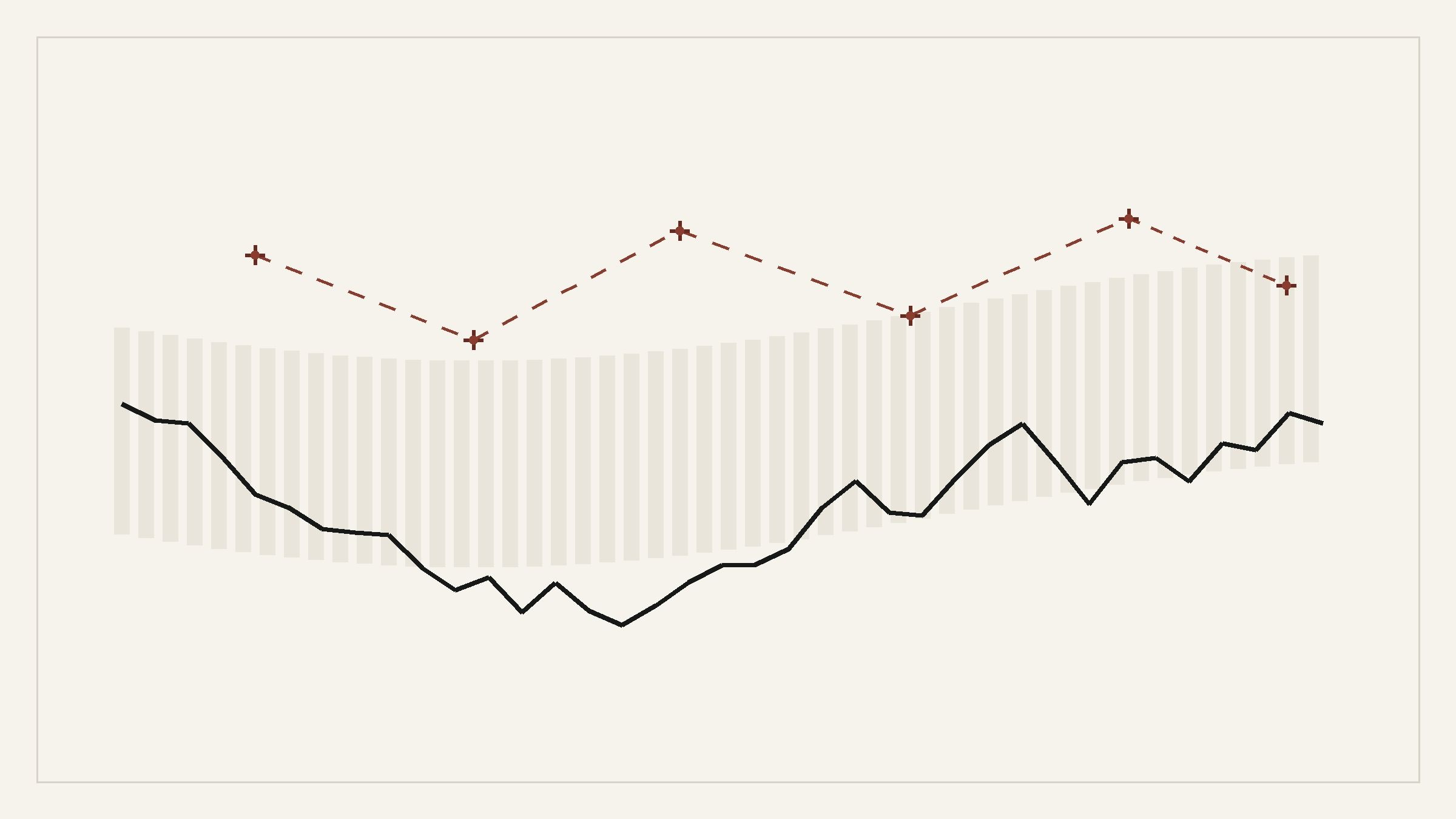
The decimal point also performs a subtler trick: it implies that a model exists, that the model has been tested, and that its past errors are small enough to justify the third digit. For interest rates, home prices, and recessions, the honest error bars are usually wider than the entire range of forecasts published in any given year. When every major forecaster clusters between 5.5 and 6.5 percent and the actual outcome lands at 7.9, the profession did not narrowly miss. The cluster itself was false comfort: analysts anchoring on each other, because being wrong together is safer than being wrong alone.
Why smart people keep listening
Uncertainty is not merely uncomfortable; it is operationally inconvenient. Businesses must hire, borrow, buy inventory, choose markets, and allocate capital without knowing what comes next. Investors must act before all relevant information is available. A confident forecast converts an open question into a decision that feels defensible.
There is also an institutional version of this comfort. A committee that acts on a respected firm’s forecast has cover if the forecast fails: everyone relied on it, so no one is to blame. In that sense the forecast functions less like information and more like insurance: not against the outcome, but against responsibility for it.
That emotional service is valuable even when the forecast is not. It provides a story, and stories reduce the sensation of randomness. The professional class is not immune to that need. It may be the core market for it, because the more a livelihood depends on the future, the more attractive it is to believe that someone can see the target no one else can.
The forecast is often less a service about the future than a service for the present: it makes action feel safer.
Forecasts can hide value judgments
Market predictions are also shaped by incentives. A brokerage benefits when people transact. An investment manager benefits when investors remain invested. A media outlet benefits when the forecast is strong enough to become a headline. A consultant benefits when the future appears legible with the right framework.
Notice how often the housing forecast of a company that profits from transactions concludes that now is a good time to transact: in rising markets because prices will keep rising, in falling markets because opportunity has arrived, in flat markets because stability has returned. When every possible input produces the same recommendation, the recommendation was not an output of the analysis. It was an input.
Those interests do not automatically make the analysis false. They tell us which assumptions deserve extra attention. Ask what the forecaster sells, which outcome supports that sale, and whether the forecast would be communicated with the same confidence if the incentives pointed the other way.
What honest uncertainty sounds like
The alternative to confident prediction is not a shrug. It is disciplined conditional thinking. Instead of one point estimate, use a range. Instead of one story, build several scenarios. Instead of pretending to know what will happen, identify what would make each outcome more or less likely.
A useful forecast might sound like this: Here are three plausible paths. Here are the assumptions behind each. Here are the signals that would cause me to update. Here is what each path would do to the business. Here is the decision that remains survivable across all three.
Research on forecasting supports this posture. The best-documented finding in the field (from decades of tournaments in which thousands of forecasters made scored predictions) is that the people who beat the averages were not the boldest or the most credentialed. They were the ones who thought in probabilities, started from base rates, updated in small increments when evidence arrived, and treated their own views as hypotheses rather than possessions. The confident hedgehog with one big idea made better television. The cautious updater made better forecasts.
That approach is less quotable because it does not compress the world into a headline. It is more useful because the goal is not to win a prophecy contest. The goal is to make a decision that can withstand surprise.
Judge the process, not one lucky result
A correct forecast can come from a weak process, just as a good decision can produce a bad outcome. One lucky call proves very little. What matters is the repeated pattern: Were probabilities calibrated? Did the forecaster update when evidence changed? Were base rates considered? Were misses acknowledged? Did the method improve?
This is especially important in markets, where a dramatic call can be right once and build a career. The same person can then spend years explaining why later misses were almost right. We remember the spectacular hit and forget the full sequence. The financial media compounds the problem by booking guests for the drama of their views rather than the quality of their records: nobody promotes a segment titled “Analyst With Well-Calibrated Probability Ranges Sees Several Plausible Paths.”
Five questions before acting on a forecast
- What exactly is being predicted? Look for a measurable outcome and a defined deadline.
- What probability or range is attached? Certainty language without calibration is a warning sign.
- What would change the forecaster’s mind? A claim that cannot be updated is closer to identity than analysis.
- Where is the public record? Evaluate the full history, not the one call featured in the biography.
- Who pays when the forecast is wrong? Advice deserves more weight when the forecaster bears some consequence or reputational cost.
Two additional questions belong to the decision-maker: What happens to me if this is wrong, and can I structure the decision so I survive that outcome? Those questions are often more important than whether the forecaster wins. A family that buys a home it can afford under several rate scenarios does not need the rate forecast to be right. An investor who would be ruined by one wrong macro call has a position problem, not a forecasting problem.
Use forecasts as inputs, not instructions
A forecast can reveal assumptions, identify variables, or force a useful scenario. It can be valuable even when its headline number is not. The mistake is allowing borrowed certainty to substitute for a decision process.
Before giving a market prediction weight, ask whether the person keeps score and whether error carries a cost. If the answers are no and no, treat the claim accordingly. It may still be an interesting story. It is not a foundation sturdy enough to carry a business, a portfolio, or a life.
The future does not become more knowable because a chart is attached. Good judgment begins when we stop demanding certainty and start building decisions that can survive without it.
Books & further reading
Affiliate disclosure: As an Amazon Associate, I earn from qualifying purchases. I recommend these books because they are relevant to the subject, not because of the commission.
- Superforecasting: The Art and Science of Prediction — Philip E. Tetlock and Dan Gardner. A practical account of calibrated probability, updating, scorekeeping, and the habits that distinguish stronger forecasters.
- The Signal and the Noise — Nate Silver. An accessible examination of why prediction succeeds in some fields, fails in others, and improves when uncertainty is modeled honestly.